By George Fazaa, MA candidate in clinical & counselling psychology
Many newcomers to Canada arrive with hope, investing their skills to build a new home; however, on several occasions, the path to Canada is layered with experiences of displacement and trauma. These experiences are often compounded by language barriers, economic uncertainties, familial separations, and experiences of violence, racism, and discrimination, which place newcomer communities at a heightened risk for mental health inequities and can heighten negative health outcomes (George et al., 2015; Salami et al., 2019).
Research also shows that immigrants and refugees are less likely to access early mental health care and are more likely to seek help only when their distress becomes severe, often through emergency or crisis services. This pattern reflects a gap in preventative and accessible pathways to care for newcomers (Durbin et al., 2015; Salami et al., 2019). Integrating artists into interprofessional mental health and settlement teams offers a practical and promising approach to addressing this gap. Artists can become a bridge for newcomers to access services long before a health issue become acute offering a preventative care strategy.
Why do artists matter for newcomer mental health?
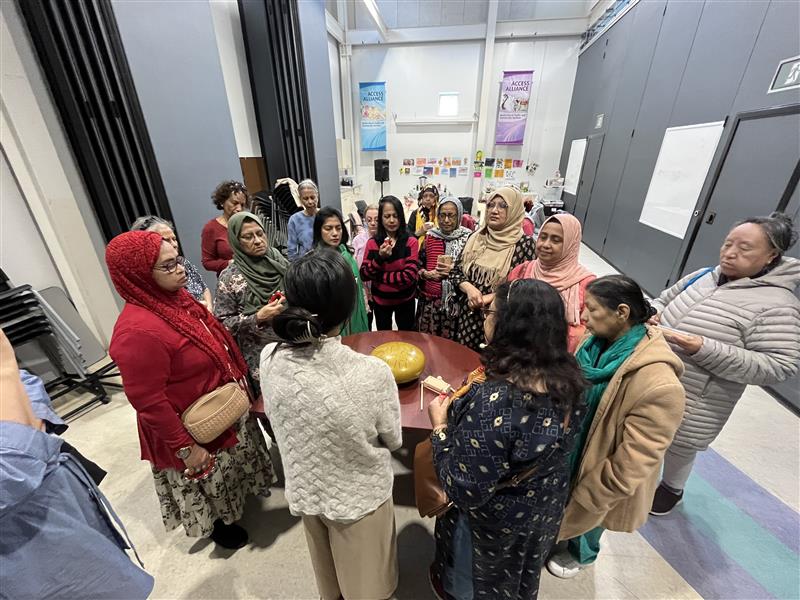
The arts have long been used across cultures as collective practices for healing and meaning-making. In many non-Western, collectivist cultures, music, movement, storytelling, drawing, and painting are embedded in everyday practices as ways to connect and make sense of hardships (Draper-Clarke & Green, 2023). For many newcomers, engaging in the arts may feel more familiar and less stigmatizing than formal mental health services, thereby increasing engagement, especially early on (McLeod et al., 2020).
Artists bring a distinct set of skills that not only complement the work of clinicians, social workers, and settlement staff, but are themselves important health workers. Arts-based work can support self-expression and processing trauma or migration without requiring high linguistic fluency resulting in structured experiences that support safety and emotional regulation without forcing disclosure (Malchiodi, 2020, 2023). This is especially appropriate when newcomers are building fluency and confidence in a new language and may be navigating mistrust or uncertainty in their lives.
Community artists as pathways into care
Many newcomers have reported not being connected to mental health systems through clinical referrals, but through community programs and settlement services (Salami et al., 2019). Community-based art programs can serve as an accessible, less stigmatizing entry point into care, where support can be offered without requiring a diagnosis or advanced language proficiency, and where trust and rapport can be built before introducing other, more formal supports (Goodman-Casanova et al., 2024; McLeod et al., 2020).
Community-led arts programs working with newcomers have demonstrated increased participation in wellbeing initiatives, as well as improved trust and openness to referrals for health and settlement supports, with participants often reporting that arts programs make them feel safer and less judged (McLeod et al., 2020).
Art-based therapists within mental health teams
Art-based therapists bring specialized clinical training that integrates creative modalities with trauma-informed practices. Expressive arts therapies engage sensorimotor and emotional systems that are crucial for trauma recovery by incorporating both non-verbal and verbal art forms, including music, drawing, collage, and dance (Malchiodi, 2020, 2023; Ugurlu et al., 2016). Evidence from work with trauma-affected displaced populations also suggests that creative and arts-based interventions can support distress reduction and psychosocial functioning (Ugurlu et al., 2016).
When embedded within interprofessional teams, art-based therapists can:
In integrated service models supporting survivors of violence and displacement, art-based therapies have been associated with improved engagement, reduced distress, stronger connections, and enhanced feelings of safety and empowerment (Malchiodi, 2023; Skop et al., 2022). These findings show how including art-based therapists within mental health teams can strengthen team capacity and improve mental health outcomes of newcomers.
Prevention, sustainability, and system impact
Internationally, artists and arts-based therapists are already integrated into interdisciplinary healthcare and trauma-informed teams, particularly in refugee-serving contexts. Ample evidence has shown that this creative care model is both feasible and practical, yet it remains underutilized in Canada (Malchiodi, 2020, 2023; Ugurlu et al., 2016; Srolovitz et al., 2022). From a public health lens, integrating artists into mental health and settlement teams supports:
Sustainability matters. If artists are funded only as short-term or peripheral add-ons to interprofessional teams, the system loses the continuity that makes prevention and early engagement effective in the first place. Artists cannot and should not replace clinicians, social workers, or settlement professionals. However, they have the potential to expand a team’s reach by strengthening engagement and opening pathways into care that many newcomers would otherwise avoid or never access (Salami et al., 2019; Malchiodi, 2023). Integrating community artists and art-based therapists into interprofessional mental health and settlement teams is a practical, evidence-based investment that bridges healthcare, settlement services, and community life, thereby supporting wellbeing earlier, more equitably, more efficiently, and more sustainably
References:
Del Río Diéguez, M., Jiménez, C. P., & Ávila, B. S. A. (2024). Art therapy as a therapeutic resource integrated into mental health programmes: Components, effects and integration pathways. The Arts in Psychotherapy, 91, Article 102215. https://doi.org/10.1016/j.aip.2024.102215
Draper-Clarke, L., & Green, C. (2023). African wisdom traditions and healing practices: Performing the embodied, contemplative, and group-based elements of African cosmology, orality, and arts modalities. Creative Arts in Education and Therapy, 9(2), 151–163. https://doi.org/10.15212/CAET/2023/9/14
Durbin, A., Moineddin, R., Lin, E., Steele, L. S., & Glazier, R. H. (2015). Mental health service use by recent immigrants from different world regions and by non-immigrants in Ontario, Canada: A cross-sectional study. BMC Health Services Research, 15(1), Article 336. https://doi.org/10.1186/s12913-015-0995-9
George, U., Thomson, M. S., Chaze, F., & Guruge, S. (2015). Immigrant mental health, a public health issue: Looking back and moving forward. International Journal of Environmental Research and Public Health, 12(10), 13624–13648. https://doi.org/10.3390/ijerph121013624
Goodman‐Casanova, J. M., Guzman‐Parra, J., Mayoral‐Cleries, F., & Cuesta‐Lozano, D. (2024). Community‐based art groups in mental health recovery: A systematic review and narrative synthesis. Journal of Psychiatric and Mental Health Nursing, 31(2), 158–173. https://doi.org/10.1111/jpm.12970
Malchiodi, C. A. (2020). Trauma and expressive arts therapy: Brain, body, and imagination in the healing process. Guilford Press.
Malchiodi, C. A. (2023). Trauma‑informed expressive arts therapy. In C. A. Malchiodi (Ed.), Handbook of expressive arts therapy (pp. 142–154). The Guilford Press.
McLeod, H., Lewis, L. B., & Li, X. (2020). Resilience and hope: Exploring immigrant and refugee youth experiences through community-based arts practice. Engaged Scholar Journal, 6(2), 88–104. https://doi.org/10.15402/esj.v6i2.70765
Salami, B., Salma, J., & Hegadoren, K. (2019). Access and utilization of mental health services for immigrants and refugees: Perspectives of immigrant service providers. International Journal of Mental Health Nursing, 28(1), 152–161. https://doi.org/10.1111/inm.12512
Skop, M., Darewych, O. H., Root, J., & Mason, J. (2022). Exploring intimate partner violence survivors’ experiences with group art therapy. International Journal of Art Therapy, 27(4), 159–168. https://doi.org/10.1080/17454832.2022.2124298
Srolovitz, M., Borgwardt, J., Burkart, M., Clements-Cortes, A., Czamanski-Cohen, J., Ortiz Guzman, M., Hicks, M. G., Kaimal, G., Lederman, L., Potash, J. S., Rubin, S. Y., Stafford, D., Wibben, A., Wood, M., Youngwerth, J., Jones, C. A., & Kwok, I. B. (2022). Top ten tips palliative care clinicians should know about music therapy and art therapy. Journal of Palliative Medicine, 25(1), 135–144. https://doi.org/10.1089/jpm.2021.0481
Ugurlu, N., Akca, L., & Acarturk, C. (2016). An art therapy intervention for symptoms of post-traumatic stress, depression and anxiety among Syrian refugee children. Vulnerable Children and Youth Studies, 11(2), 89–102. https://doi.org/10.1080/17450128.2016.1181288