16 Days of Action acknowledges that violence against immigrant and refugee women is multiplied by race, immigration status, and gender identity. Immigrant and refugee women who experience gender-based violence face unique barriers and challenges to disclosing and reporting abuse, accessing supports and services, and navigating complex legal processes and unknown social support systems. They are marginalized in multiple ways. The violence they face is compounded by different systems of discrimination. They are not always believed, and face challenges accessing support and finding safety.
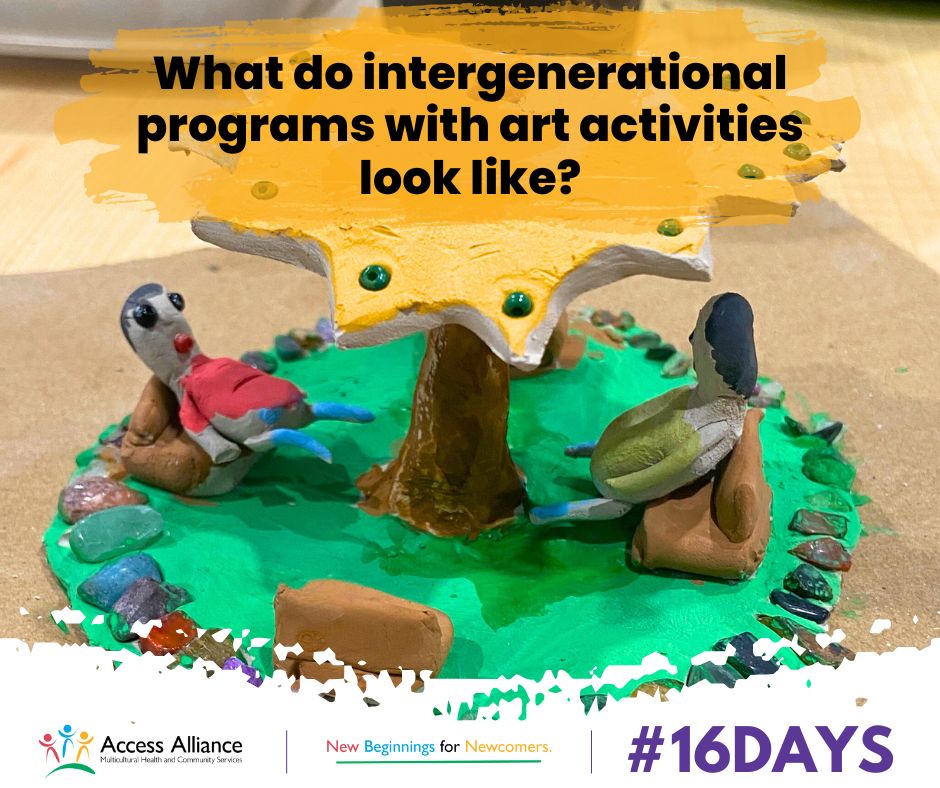
This year, we have focused our 16 Days of Activism on the effective healing impacts of expressive art for newcomer survivors of gender-based violence (GBV). Arts, Settlement, and Community Health organizations can integrate expressive arts within violence prevention programming to improve survivors’ mental health. Join us as we share how art can heal.
Over the 16 days we’ll be inviting you to reflect on different questions related to how art can be an important part of improving mental health. Follow us on the social channel of your choice, we’ll be posting on Facebook, Instagram, X, and LinkedIn. As each post is shared we’ll add it to this page below.
If you need help now, you can call 211 for support and information.
Access Alliance has been developing and holding expressive arts therapy groups since 2004. Expressive arts therapy offers powerful tools for self-regulation and stress reduction. Through movement, visual imagery, touch, and sound, these therapies engage the body and mind, promoting emotional soothing and physiological changes. Rhythm, a key element in all arts, helps stabilize and create a sense of safety, making it effective for both calming hyperactivation and energizing during withdrawal.
Expressive arts therapy uniquely promotes exploration beyond traditional talk therapy. Through mirroring and entertainment, therapists use art, music, drama, and movement to create sensory-rich experiences that synchronize rhythms and promote self-regulation. These techniques help newcomer women feel safe, connected, and in tune with themselves and others. Expression through art, movement, and sound affirms life, creating transformative moments.
Expressive arts help participants express life stressors, trauma and experiences of migration through creative mediums. It is an effective means of reducing social isolation as it encourages clients to express themselves authentically while having their identity embraced by their peers.
Expressive arts can be particularly helpful to clients facing language barriers as it offers a medium of expression beyond verbal language. We use a variety of expressive arts mediums including visual arts, music, photo-voice, dance, spoken word, and embroidery to support the well-being of community members.
Our community work, service delivery, and research illustrate how art programs at Access Alliance can improve survivors’ mental health. Find out more on these pages:
The 16 Days of Activism against gender-based violence is an international campaign that runs annually from November 25 (International Day for the Elimination of Violence against Women) to December 10 (Human Rights Day). During this time, we also commemorate Canada’s National Day of Remembrance and Action on Violence Against Women.
The campaign emphasizes reaching marginalized populations, including immigrants, refugees, and others who are often at heightened risk of gender-based violence. The initiative specifically aims to ensure that no one is left behind in efforts to end gender-based violence.
As we share knowledge on how Arts, Settlement, and Community Health organizations can integrate art within violence prevention programming to improve survivors’ mental health we also acknowledge other campaigns and themes during this time.
The Government of Canada’s 16 Days of Activism theme for 2024 is Come Together, Act Now. It emphasizes how crucial it is to involve everyone in Canada – particularly men and boys – in changing social norms, attitudes and behaviours that contribute to gender-based violence. It is also a call to action urging all of us to recognize the signs of gender-based violence and to reach out for support, for ourselves or loved ones.
The Canadian Federation of University Women’s campaign has three focus areas: Violence Against Indigenous Women and Girls, Violence Against Women in Politics, and Gun Violence.
Hope for Refugees International is hosting an afternoon/evening event on November 28th – Voices for Change: Ending Gender-Based Violence Among Refugees and Newcomers. The Voices for Change event will raise awareness about gender-based violence experienced by refugees, newcomers, and 2SLGBTQI+ communities, shining a light on the unique challenges faced by survivors.