By Lana Cho and Arla Dakli, Community in health student placement
For most of us, home is a comforting space to begin and end the day. However, this is not true for everyone. An alarming number of Canadians experience domestic violence: Statistics Canada reported that 432,000 women and 279,000 men reported having experienced intimate partner violence between 2014 and 2019 (a figure that is likely higher due to underreporting).
The definition of domestic violence is also important as it underscores the fact that violence comes in many forms. It is defined as any violence committed within the home including physical, sexual, emotional or psychological, financial or economic, and digital violence. November is Domestic Violence Awareness Month. This is an opportunity for us to learn about what domestic violence is, how it affects people, and what resources are available for survivors of domestic violence. Access Alliance provides some of these resources, including expressive arts programming to improve mental health.
Expressive arts as a way to improve mental well-being
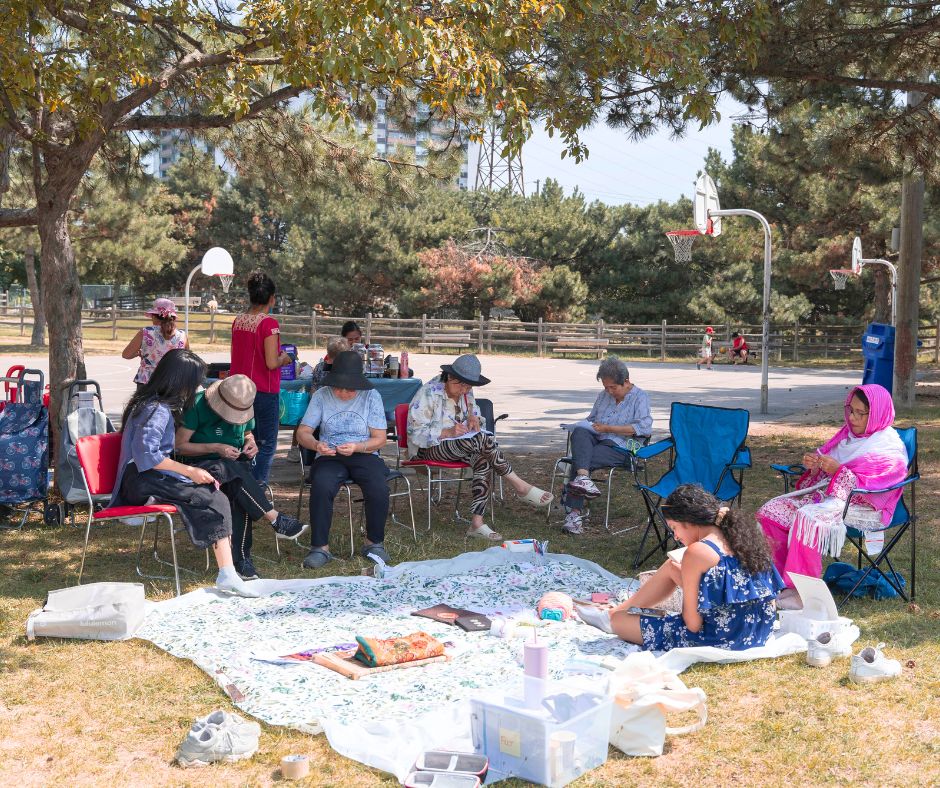
Expressive arts uses various art forms (e.g. visual arts, music, movement, performance, etc.) to improve mental and physical wellbeing. Access Alliance expressive arts programs started in 2002 and over the last two decades has evolved into a team-based and culturally sensitive program that integrates the help of healthcare professionals. Expressive arts groups provide individuals with transformative experiences to mitigate social isolation, strengthen community connections and promote self-care and wellbeing. The groups are geared primarily towards newcomer women.
Most recently, Access Alliance facilitated a program called ‘New Beginnings: Our Stories’. Newcomer women were guided through reflective journaling and art-making with oil pastels to reflect on safe and special places in their lives. This experience supported positive thinking and self- expression in a setting with others who share similar life experiences.
Reclaiming a sense of home
Despite relocating to a new living situation away from their aggressor, victims of domestic violence are likely to experience post-traumatic symptoms. Arts-based activities that are guided by a mental health professional or art therapist can support participants to develop the necessary coping mechanisms to understand difficult emotions or feelings, and ultimately find ways to learn to live with their traumatic pasts.
This helps newcomer individuals to increase their understanding of themselves and encourage them on their journey towards healing. In other words, no matter what past traumas or stories participants may experience, connecting the mind, heart and hands is helpful in re-imagining their homes as safe and special places.
Learn more about our expressive art programs https://accessalliance.ca/programs-services/community-programs/expressive-arts/