By Christen Kong, Health promoter and HEAL project coordinator
What does settlement sound like? Listen closely.
For many newcomers, the “settlement process” can sound like intake forms, stretched silences, waiting for a court hearing, unfamiliar languages, and the quiet weight of navigating systems that feel complex. These are the everyday soundscapes that are often marked not by connection, but by uncertainty and isolation.
But what if it sounded different?
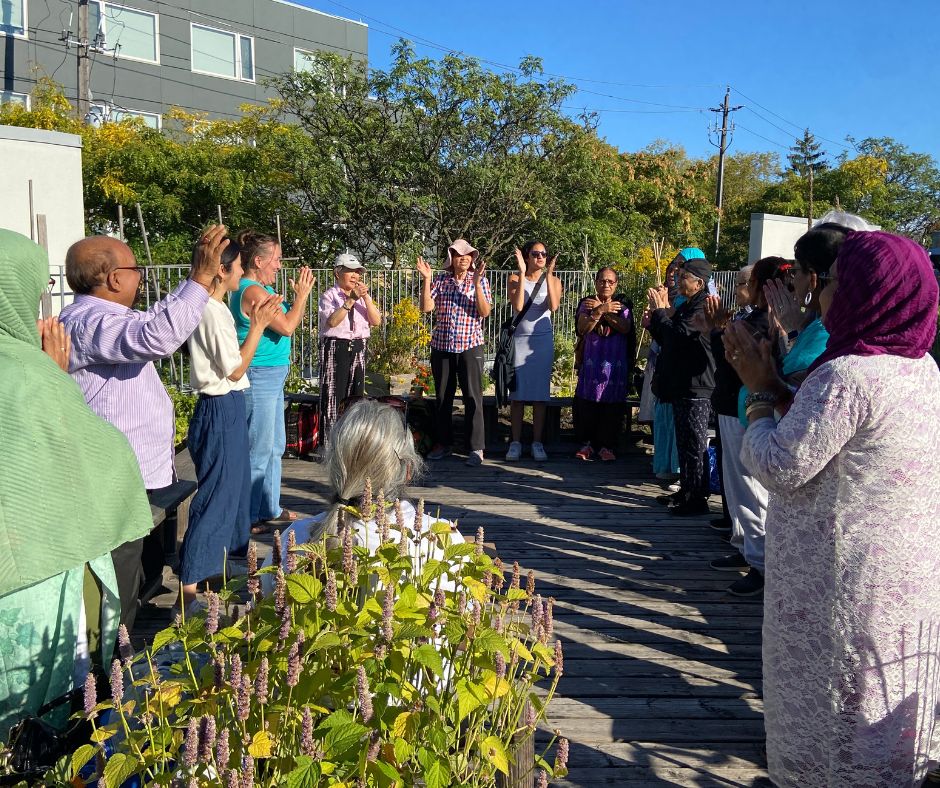
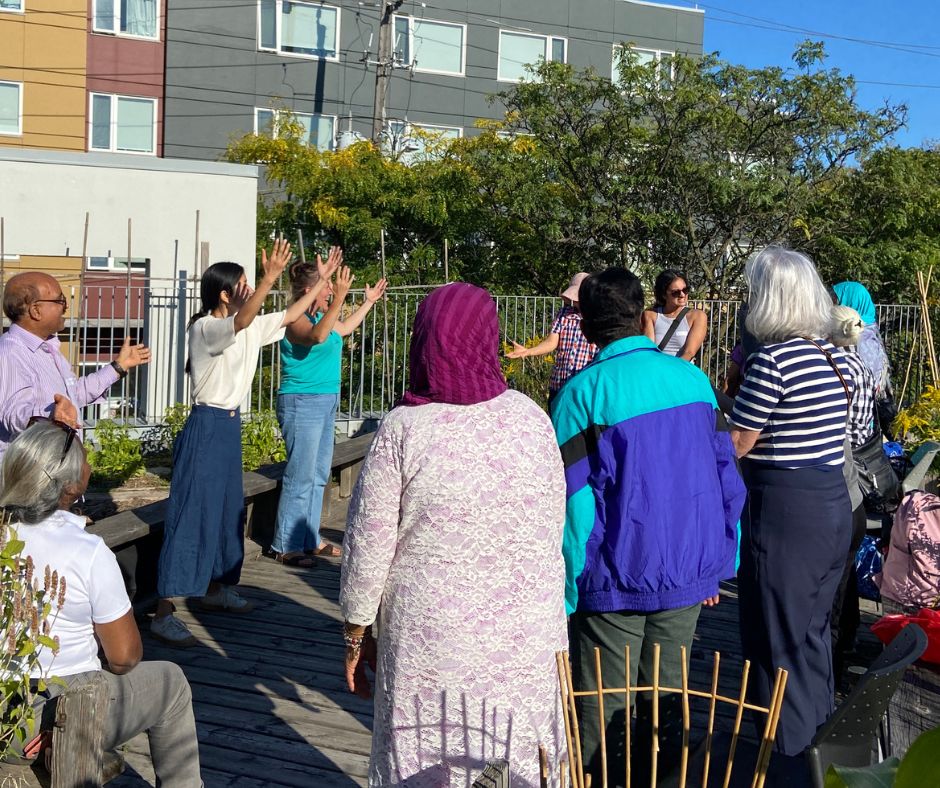
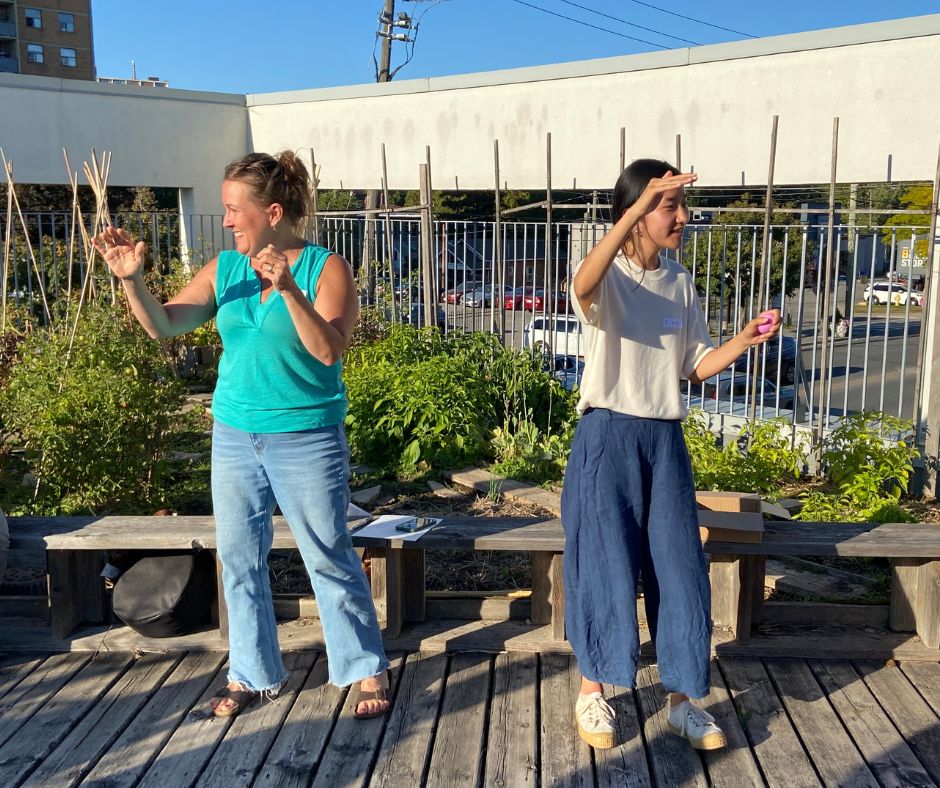
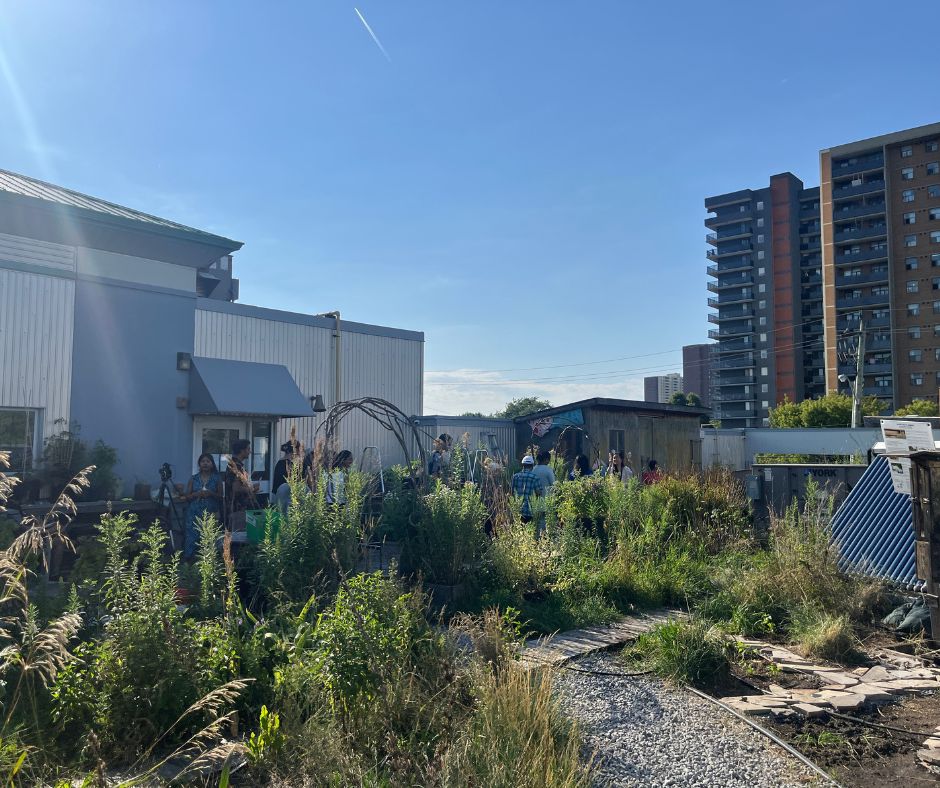
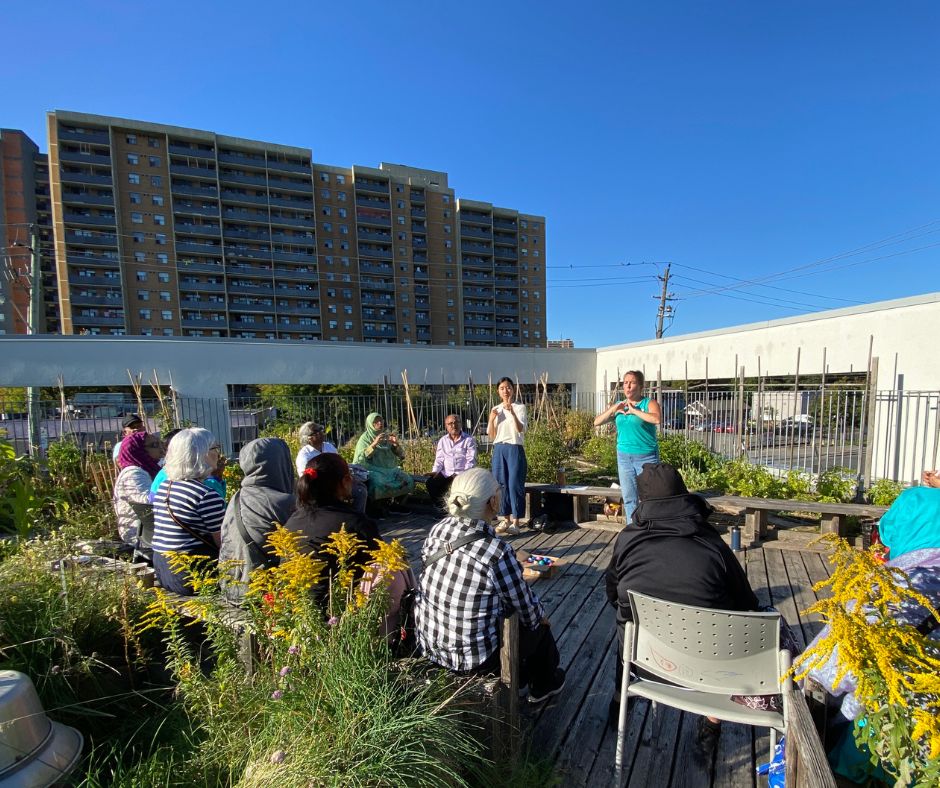
At Access Alliance, we continue to explore ways to reimagine newcomer health approaches that move beyond paperwork, and instead center connection, creativity, and community. One such initiative is the Community Singing Circle funded by the Ontario Arts Council. It was led and co-developed by expressive arts facilitators Kate Keenan and Rieko Asaba. From September 2025 to March 2026, the duo hosted weekly drop-in singing sessions at AccessPoint on Danforth on the rooftop garden on sunny and warm days. Reaching an average of 18 – 20 participants each session, the program brought together a diverse group of inter-generational community members.
Relational melodies
For Keenan, this work is deeply personal. “I’ve been an artist my whole life. I’ve loved music, acting, and creating with my hands,” she shares. “It’s about being present in the moment with people and using art to bring out the resources within each of us in a shared, community-building way.” This emphasizes that arts are not adjacent to settlement, but a valuable pathway to a more compassionate journey together.
The singing circle itself is intentionally simple. There is no sheet music and no expectations of technical skill. “It’s about joining our voices together without barriers,” Keenan explains. “No need to read music, no requirement for language, it’s not about performance or instruction; it’s about being together in the moment.”
This approach creates what might be called a circle without hierarchy. There is no pressure to perform. Instead, participants support one another, often forming connections that extend beyond the sessions themselves. For individuals who may feel isolated or unsure of where they belong, this kind of space can be transformative.
Asaba understands this experience firsthand. “I immigrated to Canada 14 years ago,” she reflects. “Language was difficult, but more than that, it was hard to find fun, accessible activities or even know what existed. I was so focused on learning the language and culture that I missed opportunities for connection.” Her insight is a common reality: newcomers are often balancing multiple priorities, language learning, employment, housing, leaving little room for investing in their mental health, wellbeing, and community belonging.
Inter-generational connections
A key part of the program is reflection and storytelling. Participants are invited to share what songs mean to them, memories of water, home, family, or moments of strength. These conversations reconnect individuals with their identities and lived experiences, bridging past and present.
Over time, something begins to shift. Asaba observed that participants’ confidence grew not only in singing, but in sharing their voices and stories. Trust developed. People became more willing to speak from lived experience. In one instance, a participant shared that she began singing songs from the group at home with her grandchildren, extending the impact into family life and fostering intergenerational connection. Another shared a memory of swimming, recalling a sense of strength and resilience that had stayed with her.
These moments highlight something deeper: singing is a primal human activity. Long before formal language, people used sound, rhythm, and voice to connect. Returning to this instinctive practice can be grounding, especially for those experiencing the stress of displacement. “There is also a physiological element when people sing together, their breathing and rhythms begin to align” shares Keenan. This form of co-regulation helps reduce stress and lift mood, offering what many participants describe as a “reset” after a difficult week.
Singing for language learning
Asaba and Keenan both highlight an important aspect. The singing circle helped to break down one of the most significant barriers in healthcare and settlement services: language. The repeat-after-me style allows participants to engage without needing to read or speak English fluently.
In fact, language learning often happens organically through rhythm, repetition, and shared experience without the pressure of a classroom. As one participant shares, “It helps with English and sharing my Bengali culture.” Another participant similarly shared, “Singing with others has helped my pronunciation and my confidence. During the break, I talk with people.”
For many, this singing circle is a non-threatening space to practice English conversation and speaking.
Consistency over time
Another key strength of the program is its consistency. “One of the most powerful aspects was its sustained presence over many months,” Keenan reflects. “We had time to really get to know each other not just as participants, but as people.” As the weeks passed, the group moved through seasons together, sharing celebrations, songs, and stories. “It felt like a flower unfolding,” she says, “we weren’t just attending a program; we were forming something together.”
This sense of continuity is critical in settlement and healthcare contexts, where services are often short-term and transactional. By contrast, the singing circle offers a steady, relational space one that “walks alongside” participants rather than simply serving them.
Integrating arts-based programs like community singing into settlement is not simply about creativity. It is about supporting what newcomers are seeking, including language support, community connection, new ways to strengthen family bonds, and consistency.
And sometimes, that begins with a single note, sung together.
Rieko Asaba is a community song leader, musician, and expressive arts therapist whose work centers cultural sensitivity, relational practice, and collective care. As co-facilitator of Singing Together, she brings a warm, responsive approach informed by her experience immigrating to Canada from Japan. She is also the founder of Held in Song, a song circle for caregivers.
Kate Keenan is a community song leader, composer, performer, screenwriter, and expressive arts therapist. As co-facilitator of Singing Together, she brings a warm, participatory approach to newcomer community singing. She is also co-founder of Songbirds and a song leader with Singing Mamas Toronto.