What is the role of evaluation and reflection to understand the impact of expressive arts programming?
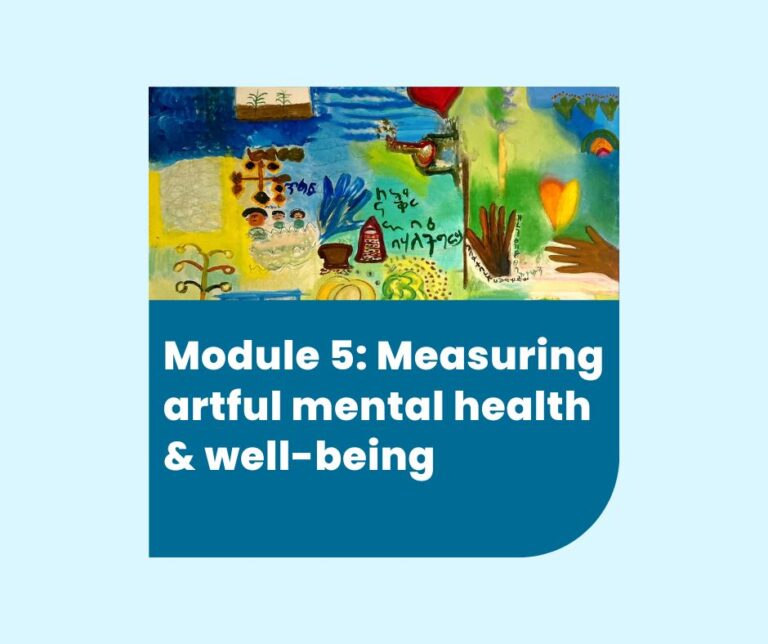
This module explores evaluation and reflection within expressive arts programming and highlights approaches that are ethical, participant-centred, creative, culturally responsive, and trauma-informed. You will learn how expressive arts can generate forms of change that are relational, embodied, cumulative, and connected to lived experience. The module invites service providers to explore participatory and arts-based approaches to feedback, storytelling, creative expression, facilitator reflection, and collaborative meaning-making, while considering how evaluation can support collective understanding without disrupting emotional safety or participant dignity.
What will you learn?
Understand how evaluation can be approached within expressive arts and trauma-informed programming
Identify creative, participatory, and culturally responsive approaches to measuring impact and participant experience
Explore ethical principles, facilitator roles, and reflective practices that support meaningful and participant-centred evaluation
Sections in this module
This module is organized into four sections. Each section explores a key concept or approach that supports the overall learning outcomes.
Evaluation in expressive arts programming
Measuring change over time
Ethical, trauma-informed, and culturally responsive evaluation
Artful response and additional resources
How does the course work?
Creative Pathways is a self-directed course made up of 6 modules. The modules will engage you in several topics related to GBDV and the arts, through participatory activities, videos, and additional resources. Each module will take approximately 1 – 1.5 hrs. to complete.
Acknowledgements
Creative Pathways is funded by the Public Health Agency of Canada (PHAC) to prevent and address family violence in partnership with six implementation agencies including Arab Community Centre of Toronto (ACCT), Canadian-Bangladeshi Community Services (BCS), Toronto Neighbourhood Group (TNG), Sherbourne Health, Art + Health, and the Barbra Schlifer Commemorative Clinic. Curriculum developed by the HEAL project team.