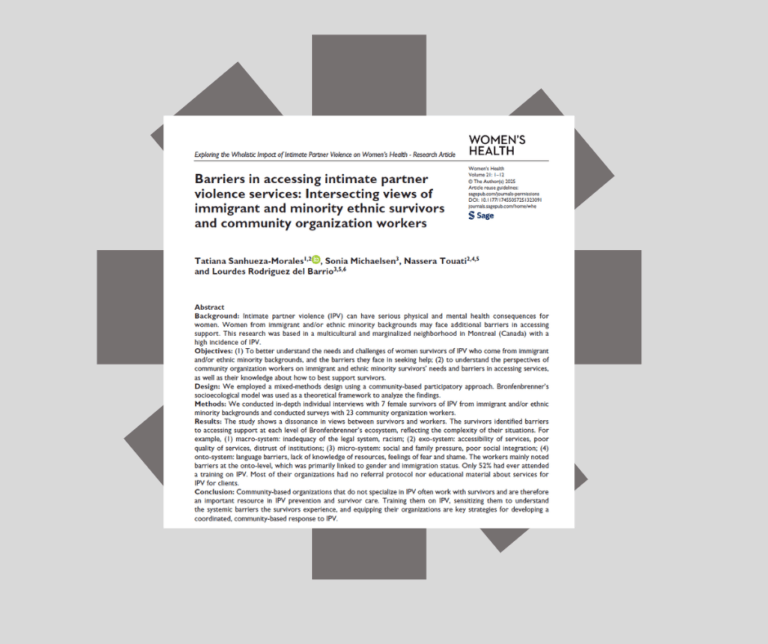
This paper examines the barriers immigrant and minority ethnic women face when accessing intimate partner violence (IPV) services in a marginalized, multicultural neighbourhood in Montreal, Canada. Using both survivor and community worker perspectives, the study highlights how systemic, organizational, and personal factors shape access to support. The authors also identify important gaps between how survivors and service providers understand these barriers, pointing to the need for more coordinated, community-based responses to IPV.
This research focuses on women survivors of intimate partner violence from immigrant and/or minority ethnic backgrounds, as well as community organization workers who support clients in marginalized urban settings. The findings are particularly relevant for practitioners, policymakers, and researchers working in health, social services, settlement, and community-based organizations.
Methodology
This study used a community-based participatory mixed-methods approach, which included:
In-depth interviews with immigrant and minority ethnic women survivors of IPV
Surveys with community organization workers
Concurrent qualitative and quantitative data collection
Analysis guided by Bronfenbrenner’s socioecological framework
Collaboration with local organizations throughout the research process
Key Findings
The study offers several important insights into barriers to IPV service access, including:
Survivors identified barriers across multiple levels, including legal systems, service accessibility, social networks, and personal circumstances.
Community workers were more likely to focus on individual-level barriers, such as language, fear, and lack of knowledge of resources.
There was a clear disconnect between survivor and worker perspectives, particularly regarding systemic and organizational barriers.
Many community workers had limited training on IPV, and many organizations lacked formal protocols or educational resources.
Why Does It Matter?
Understanding how immigrant and minority ethnic women experience barriers to IPV services is essential for improving support systems. This research:
Highlights the need for better training and resources for community workers who regularly encounter IPV survivors.
Emphasizes the importance of addressing systemic and organizational barriers, not just individual factors.
Supports the development of coordinated, community-based responses that are culturally responsive and trauma-informed.