Mapping of Canadian policies: Gender-based violence & newcomer perspectives
Research Papers
Mapping of Canadian policies: Gender-based violence & newcomer perspectives
Date: 2023
Author(s): Access Alliance Research Department, in collaboration with Sofia Karas, Dalla Lana School of Public Health placement student
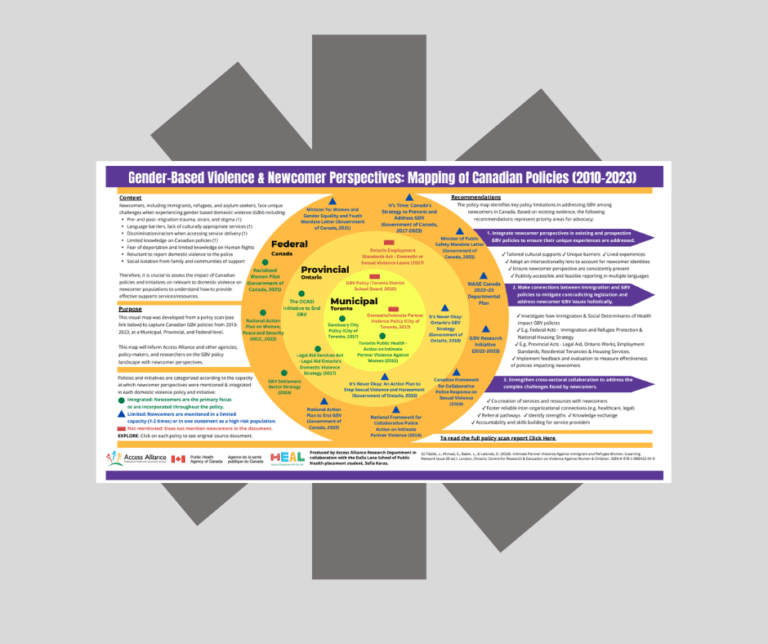
This policy map explores how newcomer perspectives are included in Canadian gender-based domestic violence policies and initiatives across municipal, provincial, and federal levels. Policies are categorized based on whether newcomer perspectives are integrated, limited, or not mentioned. The map highlights gaps in current policy approaches and identifies opportunities to strengthen supports for newcomers experiencing gender-based violence.
This policy map focuses on newcomers, including immigrants, refugees, and asylum seekers, who experience gender-based domestic violence in Canada. It highlights the unique barriers newcomers may face, including language barriers, limited knowledge of Canadian policies and rights, fear of deportation, social isolation, discrimination, and lack of culturally appropriate services.
Methodology
The policy map was developed from a policy scan of Canadian gender-based violence policies and initiatives from 2010 to 2023. The scan reviewed policies across:
Municipal level
Provincial level
Federal level
Each policy was categorized based on how newcomer perspectives were included:
Integrated: Newcomers are a primary focus or are included throughout the policy
Limited: Newcomers are mentioned briefly or only identified as a high-risk population
Not mentioned: Newcomers are not mentioned in the policy
Key Findings
The policy map found that newcomer perspectives are not consistently integrated across Canadian gender-based violence policies. Key findings include:
Some policies meaningfully include newcomer experiences and barriers.
Many policies only mention newcomers in a limited way.
Some policies do not mention newcomers at all.
There is a need for stronger links between immigration policy and gender-based violence policy.
Cross-sector collaboration is needed to better support newcomers experiencing GBV.
Why Does It Matter?
This policy map matters because newcomers experiencing gender-based violence often face complex and overlapping barriers when seeking safety and support. These barriers may include immigration concerns, language access, racism, isolation, and limited knowledge of available services. The map is useful because it identifies where current policies fall short and where advocacy is needed, including:
Integrating newcomer perspectives more consistently into GBV policies
Creating culturally responsive and accessible supports
Connecting immigration, housing, legal, health, and GBV policies
Strengthening collaboration across sectors
Supporting policy-makers, researchers, and service providers in addressing newcomer-specific needs more effectively