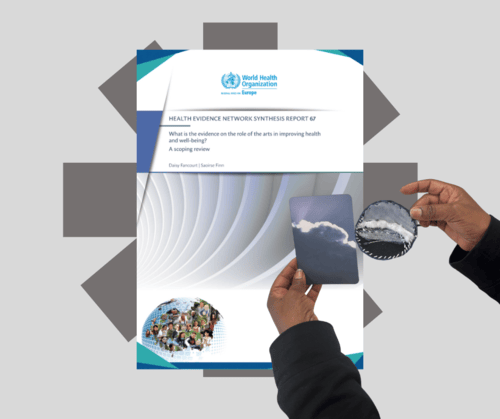
What is the evidence on the role of the arts in improving health and well-being?
Date: November 05, 2019
Author(s): Daisy Fancourt, Saoirse Finn
This World Health Organization (WHO) report reviews two decades of global evidence to explore how the arts can support better health outcomes. The report addresses a major gap by organizing existing research into a clear, accessible resource for policymakers, practitioners, and communities. The report synthesized results from over 3000 studies that identified a vital role for the arts in the prevention of ill health, promotion of health, and management and treatment of illness in a variety of cultural contexts, health and care spaces, and lifespan.
This report highlights evidence across the life course, from young children to older adults. The research is focused on global and diverse communities, including disadvantaged or marginalized populations.
Methodology
Using a scoping review methodology, the report reviewed over 900 publications in English and Russian from 2000 to 2019. The review included:
200+ systematic reviews and meta-analyses
3000+ individual studies across disciples and methodologies
Data sources ranging from psychological scales and ethnographies
Study types from randomized control trials, longitudinal studies, and surveys
Key findings
Findings were reported into two main areas: promotion/prevention and management/treatment.
Promotion and prevention:
Supporting early childhood development.
Strengthening social connections and community health.
Preventing physical and mental health conditions.
Management and treatment:
Improves outcomes for people with mental health conditions and acute illnesses.
Assists in the treatment of neurodevelopmental, neurological, and noncommunicable diseases.
Enhances quality of life through supportive and end-of-life care.
Why does it matter?
The report emphasizes the importance of integrating arts into settlement policy and urges funders, institutions, and governments to:
Enhance cross-sector collaboration between arts and settlement organizations.
Support sustainable funding models by prioritizing multi-year grants.
Address systemic barriers by recognizing international experience and embracing non-Western artistic practices.