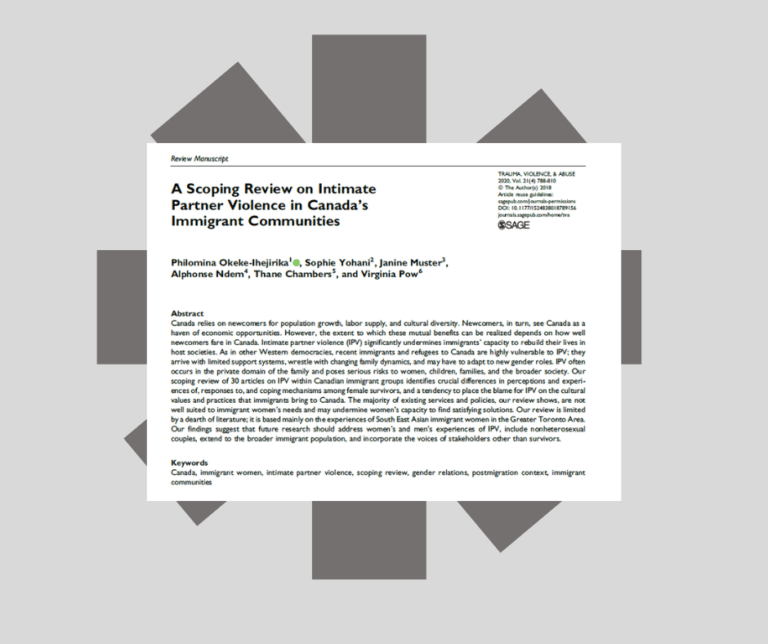
A scoping review on intimate partner violence in Canada’s immigrant communities
Date: September 3, 2018
Author(s): Philomina Okeke-Ihejirika, Sophie Yohani, Janine Muster, Alphonse Ndem, Thane Chambers, Virginia Pow
This paper presents a scoping review of existing research on intimate partner violence (IPV) within immigrant communities in Canada. Drawing on 30 studies published over two decades, the authors examine how immigrant women experience, interpret, and respond to IPV, as well as how services and policies address their needs. The review highlights important gaps in the literature and challenges common assumptions about culture, gender, and violence in immigrant communities.
This research focuses on immigrant women in Canada who have experienced intimate partner violence, with particular attention to women from South Asian and other racialized communities. The findings are relevant for researchers, policymakers, service providers, and community organizations working in violence prevention, settlement services, health, and social policy.
Methodology
This study used a scoping review approach to map existing research, which included:
Systematic searching of academic databases for Canadian studies on IPV and immigrant communities
Review of peer-reviewed articles published between 1997 and 2017
Charting and thematic analysis of 30 selected studies
Identification of key themes, patterns, and gaps in the literature
Key Findings
The review identified several recurring themes that shape understandings of IPV in immigrant communities, including:
Immigrant women’s experiences and perceptions of IPV are diverse and shaped by migration, gender roles, and post-migration stressors.
Many women rely on informal support networks and emotion-focused coping strategies rather than formal services.
Existing services and policies are often poorly aligned with immigrant women’s needs and circumstances.
IPV is frequently framed as a cultural issue, which can obscure structural and systemic factors such as immigration policy, racism, and economic insecurity.
Why Does It Matter?
This review underscores the importance of moving beyond one-size-fits-all approaches to addressing intimate partner violence. The findings:
Highlight the need for culturally responsive and structurally informed IPV services and policies.
Emphasize the value of recognizing immigrant women as active agents in their own coping and decision-making processes.
Point to critical gaps in research, including the limited focus on non-South Asian communities, men’s experiences, and diverse family structures.